Tuesday, September 22, 2015

Revisions

This year I completed my MFA and my novel Murder in the Mix. As part of the final residency for my program, each of the graduating students read a short selection from their thesis. Short, because we were limited to ten minutes. Ten minutes or the director would come and remove us from the stage.

This threat became necessary after the previous term's graduating class had a few students go long, one so much so that not even the faculty frantically clapping from the audience or wildly gesticulating at watches would get him to shut the fuck up and take his seat. And so, to prevent this assault on a weary group of faculty and student body, a strict ten minute rule was laid down as absolute. Not ten minutes and 30 seconds. Ten or less or expect to be humiliated before your peers and mentors.

Naturally, this added some anxiety to already nerve wracking requirement to perform our work in public.   And it is a performance. A delivery of lines which must represent our work, whether that is poetry, nonfiction, or fiction. So in addition to the basics,

  • Speak clearly
  • Speak loudly enough to be heard
  • Speak slowly enough to be understood
we added,
  • Don't speak too slowly, because you will get cut off mid-sentence or before the end and no one will have any idea what you were rambling about and they'll suspect that you've somehow skirted around all good writing advice your mentors must have provided and that you will die a loser, unread, unpublished, in obscurity, all your tuition wasted, your life a complete sham.
So we practiced. We read to each other in small groups around the pool during lunch breaks desperately rushing to get through our selected passages with a minute or two to spare. I was doomed, coming in around thirteen minutes, having already whittled my chosen chapter down to the essentials. Or so I thought.

First of all, it's terrible to try and hook an audience with a tiny snippet from a novel out of 241 pages. The opening didn't quite work as I have a prologue and not enough time to get anywhere in chapter one. So I selected a later chapter that I hoped would tease with humor, snappy dialogue, intrigue, a little danger, and some good old-fashioned sexual tension. They would beg me to continue!

But my essentials, my whittled down chapter, was too long by more than half. No matter how quickly I raced through it (breaking all the basic rules above) I could not deliver in less than ten minutes.

Choices had to be made. Hard ones.

At first, it was just about how much of the selection was critical for the comprehension of the audience. Cowardly. And not sufficient.

So, an entire scene was cut. Brutally. I had great sentences in there, vital clues, powerful imagery, and none of that mattered if I was yanked off the stage while still setting my scene. And then I started cutting phrases and words from sentences. Every time I read my words aloud, I found another superfluous word or sentence until I'd cut my thirteen pages to five.

I was scheduled to read on the first day of student readings after everyone else in my group. They were good. I didn't want to suck. When it was my turn, I took a deep breath and went for it, all the while terrified that I would run over. The director had interns in the back of the auditorium with time signs, but none of us could look away from our words long enough to find them. We just powered through and hoped for the best. I stopped at what hoped was a dramatic moment, waited a beat and thanked the audience. I was rewarded with gasps before the obligatory clapping. It felt fantastic.

After the crushing weight of the reading, all else - including the seminar I gave - was cake. Once I had a chance to relax, I started to think about the revisions I'd made to my reading selection. Should I go back and cut from my manuscript? How do I choose what to keep and what is cluttering up my story?

I probably made about fifty percent of the changes to that chapter of my full manuscript. I did it recently, though - not right away. I'd promised my boyfriend that I'd let him read my novel in spite of my sensitivity to his hatred of commas. I wanted him to judge me based on my best work, though, so before I hit print, I went back and made changes to the section I'd read until it sang.

He hasn't read it yet.

In any case, I found myself needing to apply similar revisions to the clutter clogging up my house. For the past few weeks, I've had to decide what to keep and what to let go. And then I'd go back and cut a little more and a little more. The determining factor has been Would I pay to store this? In most cases the answer has been no. So Craigslist or Goodwill or ecycle or whatever means that it's not burdening me anymore. I'm not missing it yet. And I can breathe.

So let your work breathe - in fact, let it sing! Decide if you would pay to store all the extra description, the backstory, the witty bon mots. If not, ship it to Goodwill and move forward with a clear conscience. You'll earn that gasp, too, and it will feel terrific.

Monday, March 2, 2015

The Poison of Self-Doubt

Those moments when we get buried in the drama of work, our personal lives, the demands of our creative projects, and our interactions with those in our lives, personal and professional, can wreak havoc on equilibrium. On our sense of stability. On our understanding of our place in the world and where we are going.

The unfortunate realities of corporate life mean that teammates and friends will come and go through our office spaces and that at any time, that meeting that pops up without an agenda could mean it's time to pack our own boxes. I feel I've aged at twice normal speed the last two years. It's soul-eroding. Especially when we are marginalized for doing our jobs, for trying to support our teams. Anxiety has become a standard part of my life.

Writing has always been how I make sense of my world,  both in how I feel (which is often complex and contradictory), and how I articulate my plan of action. It is my rudder and my outlet. I may never make a dime with it but I need it to ground me.

Sometimes, no matter how grounded we think we are, the earth shifts below our feet and all our fears rush to the surface as if we were thirteen again, standing in front of a hostile and disinterested class, completely unprepared. What if we really aren't good enough? Talented enough? Smart enough? What if we are wasting our time, our lover's time, our boss's time, our mentor's time? Might they be humoring us in person while secretly wishing we were better or more than we are?

I wouldn't have thought so, but it just take a little nudge to let doubt creep in. Once there, it grows unchecked and every movie plot, every mysterious meeting, every strange glance reinforces inadequacies whether they are imagined or not. Generally, I've been more self-assured than this, but there is a cumulative weight to consistent wear until even stone loses its definition.

Last week, an article came out about MFA programs from a former teacher attached to one. In it, the author argued a number of points which, if true, mean I'm doomed as a writer. As much as I'd like to think that my self confidence couldn't be shaken by some stranger's rambling, I can't help but remember the countless times where I've felt like a fraud, like a mistake had been made when I'd been selected, accepted, lauded, and so on. I think creative people are always secretly expecting the other shoe to drop, as if having our darkest fears realized is an inevitability. We may be more fragile than we appear. A link to to the article and a fiery response is below.

http://terribleminds.com/ramble/2015/03/01/an-open-letter-to-that-ex-mfa-creative-writing-teacher-dude/

Coincidentally, I had a conversation with a friend last week about there being two kinds of people - those who need others to do fail a bit in order to feel as they are successful, and those for whom the success of those around them is part of their own happiness and success. I have both types in my life as we all probably do. Fortunately, my MFA mentor could not be more supportive. I understand that it's his job to keep me motivated and producing pages, but his feedback always me feel worthy. It's a kindness that I don't take for granted.

So, at the risk of turning into one of those delusional movie characters who go to the closet to fetch their (figurative) pageant tiara and sash when they feel low, I try to remember the affirmations that I receive at least as much as I think about the criticisms. And I try not to underestimate the power of effort, of starting even when I might fall short, of risking my self when I am unsure, because inaction is the fastest way to fail.

And I have to trust those who love me.  I have to trust myself enough to try. If you are struggling too, know that even if we haven't met, I'm pulling for you in spirit. Get out there. I promise to be out there too.


Monday, January 19, 2015

Back to the Beginning

Beginnings are crazy - stressful, exciting, full of promise, terror, teases, but they are necessary whether trying to get a reader to Chapter 2 or starting a new year in a completely new place than the year before.

In the last few whirlwind months, I managed to get to the end of my novel-in-progress in the sketchiest, this-is-a-draft kind of way. The end. It happened.

And I met someone.

In the time between my penultimate and final semester of my MFA, both my writing life and personal life blossomed in unexpected ways. As it happens with my program, the end of a term is a prompt for the following residency, so before my month away from academic life could start, I crafted a new beginning for the novel. I took some risks. I changed points of view. Got graphic, but not so far that my reader has to turn away. If I've done this well, my character will creep into the story, creating a bond that maybe didn't exist before. The stakes are high. Her story is personal, emotional, resonant.

I work-shopped it earlier this month and there was no question about whether that was the right move. Of course, I have edits to make, slight course corrections, areas to sharpen. I am learning my way through. But it seems that my risks of late are paying off. I have my work cut out for me this term - revising the entire novel beginning to end by May - but I face it with my own sense of optimism, mixed with a little anticipatory fear, the secret sauce for good work. It means that I am committed. That I will work hard because it's important to me.

The challenge will be to allow myself time to process as I go along. I'll be using some unfamiliar structures, new voices, and I need to let them tell me where the road is when I wander off my original path. But I feel sure that my instincts are sound, that I am where I am supposed to be.

This will be a year of changes, of deadlines, possible missteps, of celebrations, but also of faith - even confidence - that my story will play out as it should. I hope yours does as well. Embrace your new beginnings.

When it works, you know.

Monday, November 10, 2014

Sense Memory

Autumn.

Pumpkin spice everything, leaves, Halloween candy, and the cozy clothes we all packed away in the spring. Except for you Florida folks as you have neither spring nor fall. The time of year when we all pick up a few pounds because the food is so good and so plentiful at the same time the weather becomes less friendly. It's so much easier to curl up on the couch.

So I took my dog for an extra long walk the last few days. We went a few blocks farther, exploring new streets. B loves it. SO many new smells, new neighborhood dogs, new squirrels, new places bunnies might hide. I also like exploring new places and feeling less guilty about the cookies I had instead of a real breakfast. (They were freshly baked and warm and hey - am I made of stone? Clearly not.)

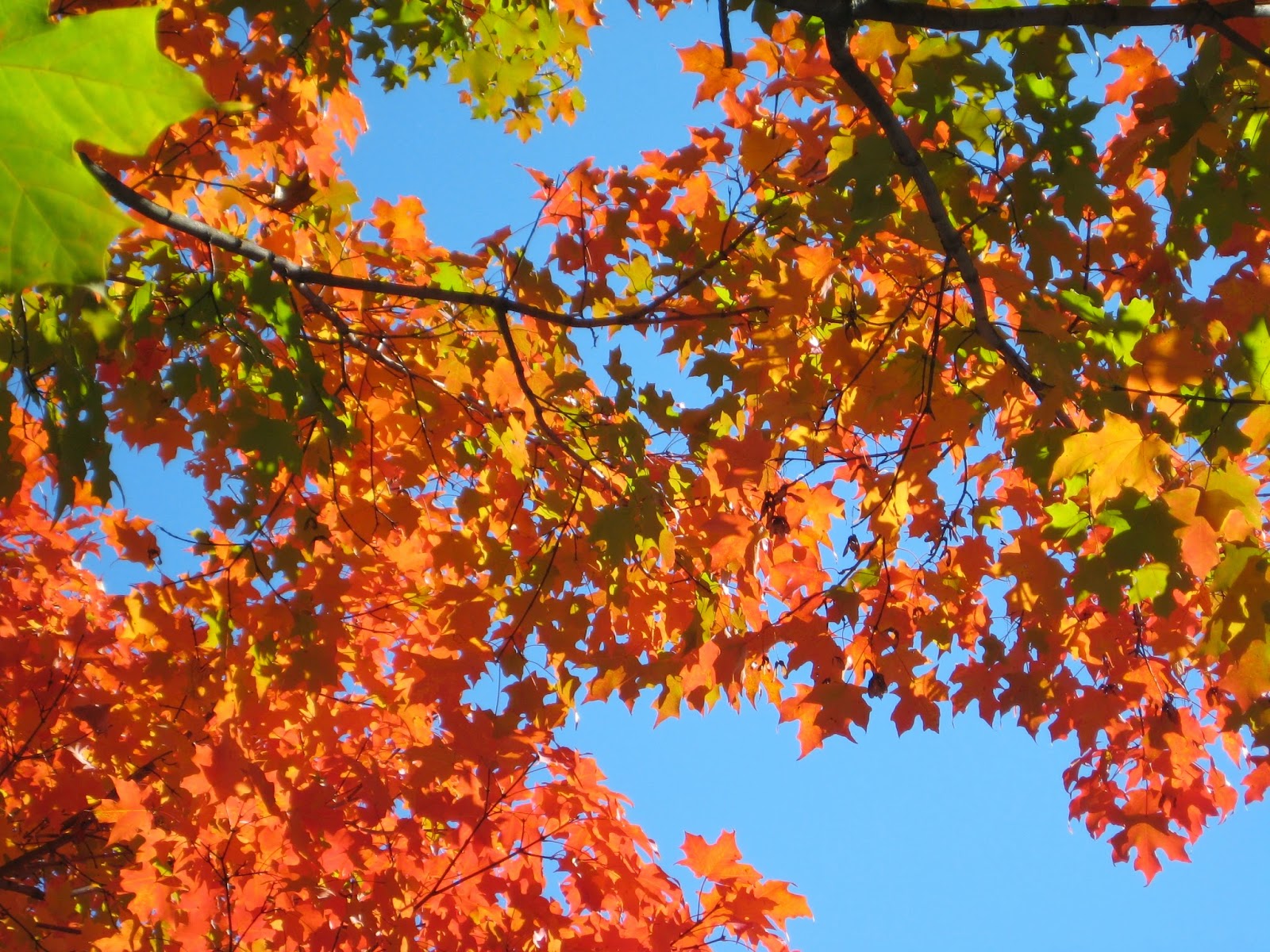
Earlier this year, I spent a semester working with the wonderful Jennifer Vanderbes.  She encouraged the use of particular details to tie a scene to reality for the reader. A color or some other sensory image that gives the reader enough to fill in their own imagination around it without doubting the scene's authenticity. For me, the sensory detail isn't the beautiful colors, although they are breathtaking. I've included some images so my Florida friends can follow along since this is completely foreign.


Right?  So this is breathtaking and all, but it's not my detail of choice. This weekend, my neighbors were out in their yards raking leaves, mulching, getting in one last lawn mow, and edging before winter comes. (I really need to do all that stuff too, better get on that) Anyway, one of my favorite smells is freshly cut grass.  The grass here and the soil it grows in smell completely different from anywhere else I've lived. There's the damp earth, with a little clay, and the wild onions that permeate the lawn. I am reminded of my childhood years here, of basements and their exterior access steps with iron railings, of brick houses, of Japanese maples, of flagstone patios, and of my grandparents.

It's distinct and rich and immediate.

Florida grass is completely different, although also pleasant. The grass is often the very coarse St. Augustine, springy and dense, and excellent cover for ants. It surrounds the swimming pools of my youth and brings to mind summer (nine months of the year), the smell of chlorine, the breezes on screened porches, and citrus and pine trees.

North Carolina has rich red clay, the smell of Lake Gaston which is always mixed with a bit of boat engine exhaust (not as unpleasant as it might seem, it reminds of summers water skiing, and lazy afternoons sipping wine on the pontoon boat in a slow tour of the lake), horseshoe pits, and barbecue chicken, ever so slightly overcooked.

Back to Maryland. At the first hint of chilly weather, the scent of wood burning fireplaces joins the symphony of outdoor aromas. Cinnamon brooms and pine cones decorate, apple and cranberry candles burn, my neighbors and I bake as it is now cool enough to justify the oven time, and we are just breaths from the scent of Christmas trees.

So as I wrap up the final chapters of my WIP knowing that I will just start again at the beginning to refine, solidify, rearrange, and complete with those sensory details, I think about which details bring my own world to life so that I can gift that same richness to my characters.

May your holiday season be full of rich, sensory details of your own. May you be able to transport back to this season with warm, nostalgic feelings tied to tastes sweet and savory, delicious aromas, the textures worn, the beautiful leaves and seasonal decorations, and the sounds of close friends and family unique to your experience.

Happy Holidays!


Saturday, October 11, 2014

Sex and the Single Girl


I'm no Helen Gurley Brown - not even a Natalie Wood for those of you who saw the film, but I have spent many years navigating relationships, both real and fictional, as a single woman. And I've written about relationships for single female characters.  The writing part is just as hard as the  real-life dating part. And, if you can believe it, sometimes way more awkward. So I decided to do some research.

My MFA program requires a third term essay - twenty five pages on some aspect of craft that should assist my literary efforts. I chose as my title Characters Behaving Badly: Writing Uncomfortable Scenes of Sex and Violence.  Right?  Sex scenes are difficult to write well. They just sound awkward or cheesy or just awful. I refer you to the 50 Shades of Grey trilogy if you doubt me, with all of Anastasia's inner goddess moments. (I will say, however, that in spite of the  book's flaws - and there are so, so many - that they sparked so much healthy conversation about sex, what's considered normal or erotic or out of bounds, along with a generous dose of curiosity, that I can't hate on them too much. Plus, the movie trailer looks hot.)

There were fewer resources for writing good sex scenes than scenes of violence, and the ones I did find were not really academic in nature. When you boil it down, though, the advice for writing both were more or less the same. In most cases, less is more, although you want to evoke a reaction. Clearly not the same reaction, but inspiring an emotional response with words is what we writers strive for. Also, how a character (or a human, single woman) deals with crime or fear or injustice tells as much as how they would interact with lovers or friends or spouses. Are they comfortable talking about it? Are they natural reactions to stress? For writers like me who tell crime stories, talking about violence is a necessity. And characters exposed to violence are likely to seek out human connection as a method for dealing with that violence, especially if there is looming danger. Carpe diem and all. So I have to practice until it becomes a skill, just like any other.

I've been blessed with great writing mentors, especially in this program, but finding mentors for one's real life is so much harder. I've mentioned in an earlier blog post that following advice from sources like Cosmopolitan or - God help you - HBO leads nowhere but disaster. Seriously. Friends might be helpful, but in the U.S. we aren't so great about communicating or educating about sex. There's Google - good luck with that. We tend to rely upon experience, so that's a lottery we might win or lose. We also tend to have completely skewed ideas about what other people are doing or know or consider normal or kinky or off limits. Finding one's way requires some trust, some courage, some luck, and some help. Please don't rely entirely on 50 Shades! Instead, take a look at this series of youtube videos that both answer way more questions than you thought you had and also can provide some insight for characters who may have different experiences, needs, issues, or assumptions from your own. Let your characters be their own people with believable critical detail. Because that critical detail is what makes the scene, no matter what  story you are telling.

Sexplanations - Bring Your Sexy Back

On a side note - I'm not terribly prudey. I think more knowledge is better than less in most cases. I think questions are usually a good idea although please see my note about context and consent below.  If you are not comfortable with sex, don't have it. If you aren't comfortable writing about it, don't do it unless it furthers your story. Don't add it for the sake of a writing checklist. And, although I understand sex as a natural expression of emotion or intimacy or release of tension between real people, I also understand that this has to be case for both parties. Consent is real and should extend to others being okay with even the discussion of sex, especially out of context. So don't assume it's fine with your coworker or your friend or even your date to launch into detail about what you do or don't do in the bedroom or on the dining room table while having coffee or lunch or even drinks in a bar. Know your audience people! On the other hand, it's hard for people to talk about it, so if someone comes to you for information, for guidance, even if the topic is uncomfortable (this could apply to so many topics), please consider speaking frankly and with understanding if you can. People are driven to desperate acts in the absence of support and information. Sometimes listening without judgment is the best help out there. Try and remember that we are all stupid and crazy and blind and brave and afraid when in love. Don't shortchange yourselves or the characters you write from the same richness of experience.

Happy writing, and if you are out there in the dating pool - best of luck to you! If you are a writer and looking for a good program, check out University of Tampa's low residency program here.

Wednesday, August 20, 2014

Fear of Commitment and Storybook Endings

My phobia list, although short, is pretty well-known in my circle. Bees, bears, and commitment. Yeah. The first two are self-explanatory (and TOTALLY understandable), but the last one is misinterpreted all the time. It's not about relationships. It's not fear of marriage or boyfriends or dating. It's about choosing a road and staying on it to the end when turning around isn't really an option. It's why I don't have a tattoo. I'd never be able to choose one and commit to it for life. Plus - ouch!

Sometimes, my heart moves too fast for my head to react and I  - oh, I don't know - quit my job and move to another state. But usually, I tend to make decisions carefully. I made color boards and surveyed coworkers and friends before choosing the samples I would paint all over my house, months before I needed a decision. I wanted to make sure I saw them in all light. So, yeah - committing to a paint color for my living room took months.

But it means that when I choose, I've probably weighed it out. Thought it through. I'm sure.

Or I've just made a wild ass guess.

Which brings me to storybook endings. Because it's time for me to choose one. For my book.

I've had an inkling about how I wanted to wrap things up for awhile. By inkling, I mean I knew who I was going to make the villain (no spoilers!) but I hadn't really worked out the details. I haven't committed to an ending.

But it's time. I am working through my last chapters and I am forced to choose, to make resolutions, to tie up loose ends I threw in, sometimes by picking from my crazy idea board. (see previous related post) Committing to an ending seems like a big deal, not only because I really don't want to fuck this all up after all the work I've done, but because it's the ending.   Not 'happily ever after' exactly, but I want it to satisfy. I want it to work.

Writers catch a lot of flak about revising things to death. We tend not to be satisfied with our own work, so we tweak it over and over and over. In a way, I'm blessed with some laziness, so the neverending loop of rewrites isn't really on my radar, because that would be exhausting. Of course, that means that I occasionally find errors way after I print or publish or submit, but so it goes.

But choosing an ending is big. And I'm too lazy to write five and see how I feel about them all over the next three months, so this one might come down to a wild ass guess.  Wish me luck!

Sunday, July 20, 2014

Memory lane has been digitized

I updated my iPhone's software this week and was surprised when I synched it back to my laptop to see that I was using most of the memory for stuff other than music. So over the last few days, I started looking through my photo files and deleting the duplicates, the accidents, the blurry takes, and the pics I won't need again - like the snap of the schedule for last week's faculty meetings so I could figure out where to go.

I haven't gotten all the way through the pics, but I did go through voicemails once I realized that I never delete those. They aren't kept for any good reason. It's not like I'm going to hunt back for a random missed call recording. I deleted almost all of them Almost all. I kept a few from people I may not hear much from anymore. For the sound of their voices. Which leads me to the text messages.

Another area I never deleted. Until today. I saved my messages from only two people. Most of the others were "hey, I'm outside" or "Meet you at 6" or things like that, so it's no disrespect to the authors that freed up that space. But the other two are different. One is starting to battle a serious illness and she is frightened. I send her messages regularly, mostly silly things meant only as a distraction and to let her know that I care. What else can I do?

The other is the entire chat history between me and a friend I met a little over a year ago. Every message between us since May 2013. I read them all today all the way back to the beginning and remembered how I felt sending them, receiving them. The entire human experience is there - our whole relationship as it unfolded. These are not messages coordinating rides or dinner plans. This is the digital history of the last year of my life. They are playful at times, concerned, angry, affectionate, sad, compassionate, informative, and kind. They are human - real. And they contain my history as much as they do for my friend. What we worried over late at night, what we did, where we went, what was going on in our lives that peripheral to the relationship with each other. There are favors and concessions, laughter and genuine caring. I read these today and remembered. Especially the kindnesses. Because what else is more worth remembering? What else could be more important?

When communication breaks down, when we lose touch with one another, or we let past differences or misunderstandings divide us from those we love, or when we lose dear ones to circumstances beyond our control, I am grateful for the ability to go back and remember when we believed each other to be special, extraordinary, to remember the kindnesses both given and received. My kindnesses were genuinely and freely given without expectation and those memories are healing in a world that moves too fast without regard for our plans or desires.

Some people will pass in and out of our lives and some will linger. I hope the ones who might be on the fence about sticking around can also remember the kindnesses they shared. I am a better person for knowing them. And anyone who inspires others to be their best deserves a place at the table for many years to come.